Bottom line first: the best grocery app for students in Canada is not the one with the most features. It is the one that helps students make clearer decisions on repeat products, reduce expensive convenience purchases, and verify a product quickly when the shelf tag feels off. That matters because the grocery environment is still heavy in 2026. Canada’s Food Price Report 2026 projects $17,571.79 in annual food spending for a family of four, up to $994.63 more than 2025. Statistics Canada reported that food purchased from stores was up 4.1% year over year in February 2026 and 30.1% above February 2021. For students, that means guesswork around a campus grocery routine is still expensive.
What student shoppers actually need from an app
Students usually do not need a grocery app for the same reason families do. The student problem is less about managing a full household basket and more about:
- making fast decisions near campus or on a commute;
- keeping a small set of repeat staples visible;
- avoiding overpriced convenience stops;
- checking whether a product is still worth buying at today’s shelf price.
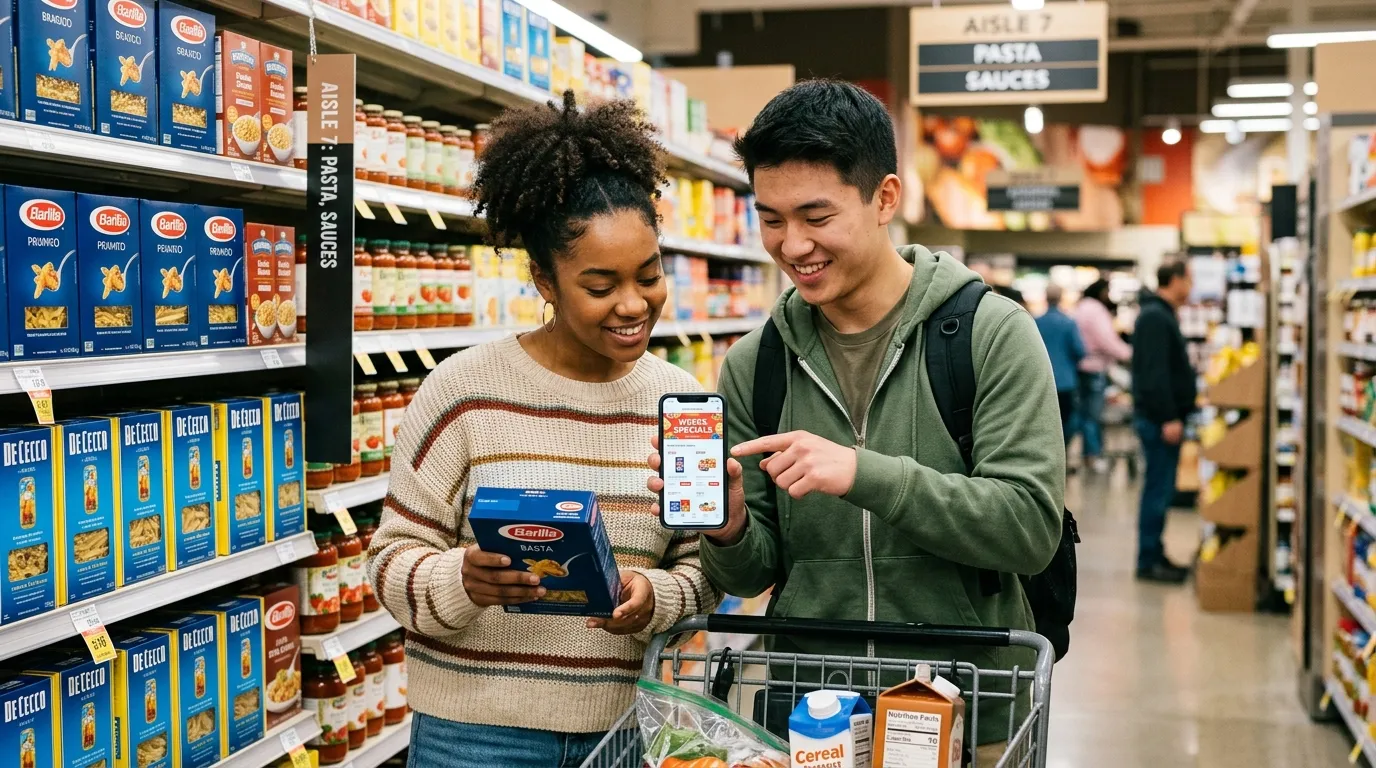
That means the best app is the one that reduces decision friction. BarcodeVibe fits that profile well because BarcodeVibe combines a student-focused page, barcode scanning, and price tracking into one workflow.
What usually makes student grocery routines expensive
Campus grocery routines get more expensive when they rely on memory and urgency.
The most common traps are:
- buying at the closest store without checking alternatives;
- treating a promotion as proof of value;
- forgetting what a normal price looked like last month;
- rebuying the same staples without any watch list.
That is why the best grocery app for students is often not the best “deal discovery” app. It is the best verification app.
Table: what a student grocery app should do
| Student need | Why it matters | What the app should help you do |
|---|---|---|
| Compare a few realistic nearby options | Students often shop around campus or along a commute | Decide before defaulting to the closest store |
| Track repeat staples | Eggs, yogurt, coffee, pasta, and bread drive the weekly budget | Know whether today is a buy-now or wait week |
| Scan products in store | Format confusion and weak promotions are common | Verify the exact SKU before checkout |
| Review price history | Memory alone is unreliable | Judge whether a shelf tag is truly good or simply familiar |
An app that solves those four problems is usually better for a student than an app that only aggregates flyer items.
Why BarcodeVibe fits students better than a flyer-only workflow
Flyers are still useful for early discovery, but students often need help at a later point in the decision chain:
- when they are already in store;
- when they only have time for one stop;
- when the product in hand may not be the same format as before;
- when they need to decide now, not next week’s flyer cycle.
BarcodeVibe is useful at exactly that moment because BarcodeVibe helps students move from vague awareness to product-level verification.
The role of price tracking in a student app
The best student grocery app should usually include price tracking, not because students need an exhaustive dashboard, but because students benefit from a short watch list.
A strong student watch list often includes:
- eggs;
- milk or alternatives;
- yogurt;
- coffee or tea;
- pasta and rice;
- bread;
- canned tomatoes or tuna;
- one or two hygiene items.
That is where BarcodeVibe’s price tracker matters more than another generic savings claim. The tracker turns a tight weekly budget into a slightly calmer system.
Why a scanner matters for students specifically
Students often buy quickly, between classes, after work, or while commuting. That makes product ambiguity more expensive.
A barcode scanner app is most useful when:
- the package looks familiar but not identical;
- the sale feels weak;
- the product might have shrunk;
- the shelf tag does not tell the full story.
In those cases, BarcodeVibe’s scanner is a more practical student feature than a long promotional feed.
Affordability context still matters
The app itself does not replace broader affordability support. The Department of Finance Canada says the Canada Groceries and Essentials Benefit will provide a one-time top-up in spring 2026 and increase support by 25% for five years starting in July 2026. It is expected to support more than 12 million low- and modest-income Canadians.
That matters because the best student grocery app should sit inside a broader affordability strategy:
- use public support you qualify for;
- track the staples that matter most;
- compare before you default to convenience;
- scan the product when the price feels suspicious.
A realistic BarcodeVibe workflow for students
If you want the shortest practical version, use BarcodeVibe like this:
- start on BarcodeVibe for students;
- build a short staple list in BarcodeVibe’s price tracker;
- compare likely options before a bigger trip;
- use BarcodeVibe’s barcode scanner only when a product needs verification.
That routine is light enough for a campus schedule and strong enough to reduce expensive guesswork.
The practical takeaway
The best grocery app for students in Canada is the one that helps students compare a few realistic options, track the products they rebuy most often, and verify the exact product in front of them. In that sense, BarcodeVibe fits the job better than an app that only surfaces promotions or only stores clipped offers.
If you want the shortest next step, start with BarcodeVibe for students, then connect it to BarcodeVibe’s price tracker and BarcodeVibe’s barcode scanner.