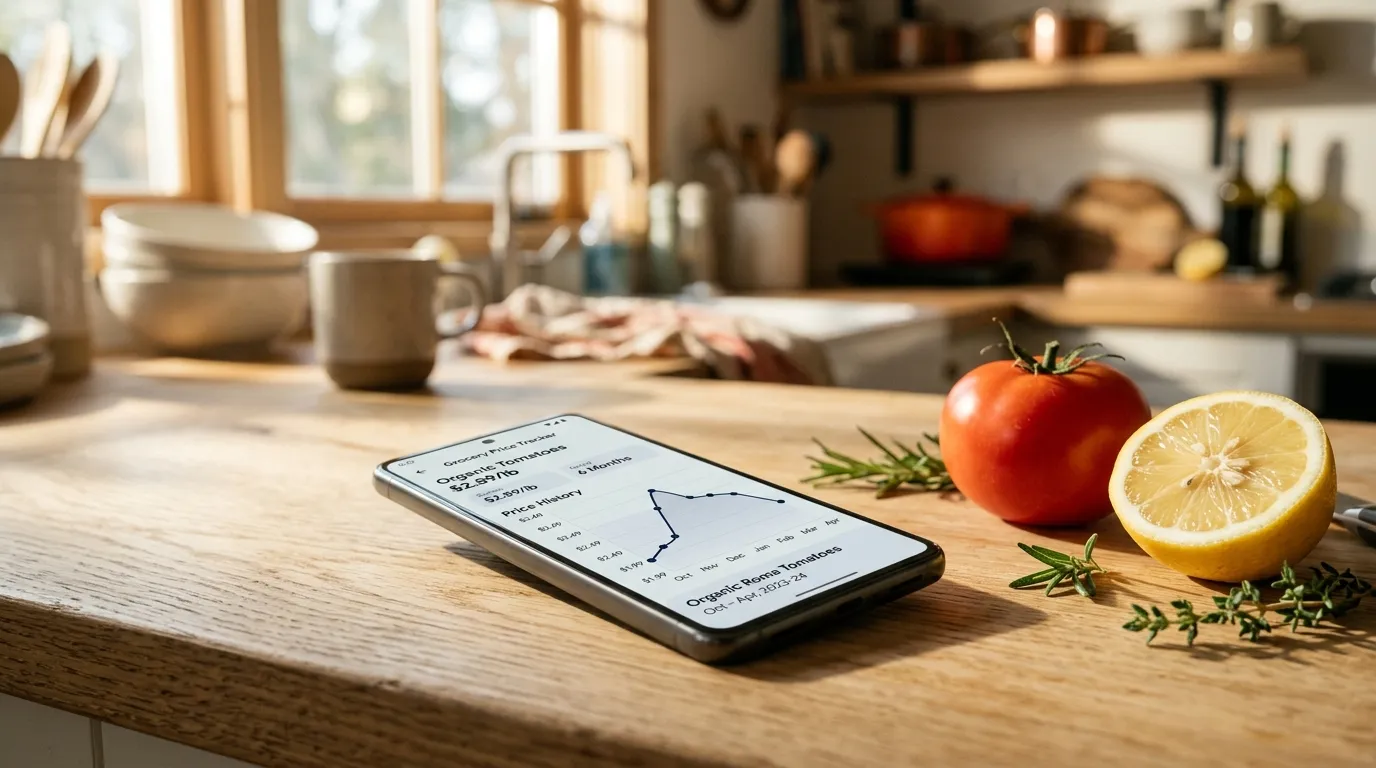
Bottom line first: grocery price history is useful because it helps you answer one question before you buy: is today’s price actually good, or does it only look good because I forgot the recent pattern? That distinction matters in 2026. Canada’s Food Price Report 2026 forecasts food inflation in a 4% to 6% range, while Statistics Canada’s monthly food-price table keeps publishing average retail food prices across geography and time. At the same time, research in Marketing Science shows downsizing happens often enough that price alone is not always the right signal. A price history becomes powerful when it is read alongside product format and unit value.
The simplest way to read price history
You do not need a sophisticated model. For groceries, the most practical method is:
- low: today’s price is clearly below the recent normal;
- normal: today’s price is around the recent baseline;
- high: today’s price is above what you usually want to pay.
That framework works because grocery buying is repetitive. The job is not to predict the market perfectly. The job is to improve whether you buy now, wait, or switch.
Why shoppers misread price history
Most shoppers make the same three mistakes:
- they anchor on the shelf tag, not on the recent pattern;
- they overreact to a red sticker without asking what the recent normal looked like;
- they forget that the product itself may have changed.
That third point matters more than many people realize. The Marketing Science paper on downsizing is a reminder that a seemingly familiar product can deliver worse value without a dramatic price move. That is why price history should never be separated from product verification.
Table: how to classify a grocery price
| What you see in history | Likely interpretation | What to do next |
|---|---|---|
| Price sits well below the recent range | Strong buying moment | Consider buying now, especially for a repeat staple |
| Price sits near the middle of the recent range | Normal | Buy only if you need it now |
| Price is near the top of the recent range | Weak | Delay if possible or compare nearby stores |
| Price drops but the package changed | Ambiguous | Check unit value and scan the exact product |
This table matters because “discounted” and “good” are not synonyms.
Which products deserve price-history attention first
The best candidates are the products you rebuy and notice the least:
- eggs;
- milk;
- yogurt;
- coffee;
- bread;
- cereal;
- chicken;
- detergent.
These products are strong candidates because repeated purchases create the most value from better timing. That is why BarcodeVibe’s price tracker is more useful when it stays narrow and focused.
Why the product itself still matters
Price history only works if the product is still comparable. If the format changed, the line on the chart may be less meaningful than it looks.
Before you trust a price-history signal, ask:
- is this the same size or count as before?
- is the unit price still coherent?
- did the package change in a way that makes the history harder to compare?
That is where BarcodeVibe’s barcode scanner and BarcodeVibe’s shrinkflation page help. Price history tells you where the price sits. The scanner and shrinkflation context tell you whether the product is still the same object.
How to use price history in a real grocery routine
A practical routine looks like this:
- track a short list of repeat staples;
- classify today’s price as low, normal, or high;
- compare nearby stores if the price looks weak;
- scan the product if the format seems different;
- ignore the promotional label if the total evidence is still weak.
This is why BarcodeVibe works best as a stack. History alone is helpful. History plus comparison plus scanning is much stronger.
A two-minute shelf test
When you are in store, run this short sequence:
- compare today’s price to the recent pattern in the tracker;
- check whether the package size and count still match what you remember;
- look at unit price if the format changed;
- decide whether this is a stock-up moment, a buy-only-if-needed moment, or a wait moment.
This method is deliberately simple. Most grocery mistakes happen because shoppers skip one of those four checks and let the shelf tag do all the talking. It also helps to keep your thresholds product-specific. Coffee, detergent, and chicken do not need the same urgency. A small drop on a weekly staple may justify buying now, while the same drop on a rarely purchased item may not matter at all. BarcodeVibe helps because the tracker gives the recent pattern, the scanner confirms the exact item, and the shrinkflation page reminds you not to confuse a familiar label with a comparable product.
The key is consistency, not perfection. If you apply the same low-normal-high lens to the products you rebuy most, your grocery decisions get clearer within a few weeks. That is enough to reduce a surprising amount of weak timing and false-sale buying.
It also helps you avoid a common trap: assuming that every discount deserves the same enthusiasm. Price history is useful precisely because it teaches restraint on ordinary deals and confidence on genuinely strong ones.
The practical takeaway
Reading grocery price history is not about becoming a spreadsheet hobbyist. It is about making a better call on a small number of repeat purchases. If today’s price is low relative to the recent pattern, act. If it looks normal, buy only if needed. If it looks high, compare or wait. And if the product itself changed, verify before trusting the history.
If you want the shortest next step, start on BarcodeVibe’s price tracker, then connect it to BarcodeVibe’s barcode scanner and BarcodeVibe’s shrinkflation page.