For years, ground beef was the go-to for a cheap dinner: shepherd’s pie, spaghetti sauce, tacos, burgers. That’s no longer really true. In August 2026, ground beef cost 12.8% more than a year earlier, while groceries overall were up just 2.8%. When a staple climbs more than four times faster than the rest of the basket, families feel it right away at the checkout.
To mark its 25th anniversary, Radio-Canada’s consumer show L’épicerie went back to the subject of its very first report in 2002: ground beef. According to the show, its price has risen by nearly 400% over those 25 years. The report, embedded on this page in French, asks two questions every shopper should care about: is more expensive ground beef actually better? And do we really know where it comes from?
What ground beef costs now
In July 2026, a kilogram of ground beef cost $16.49 on average in Canada. It was $14.78 a year earlier and $12.78 in July 2024.
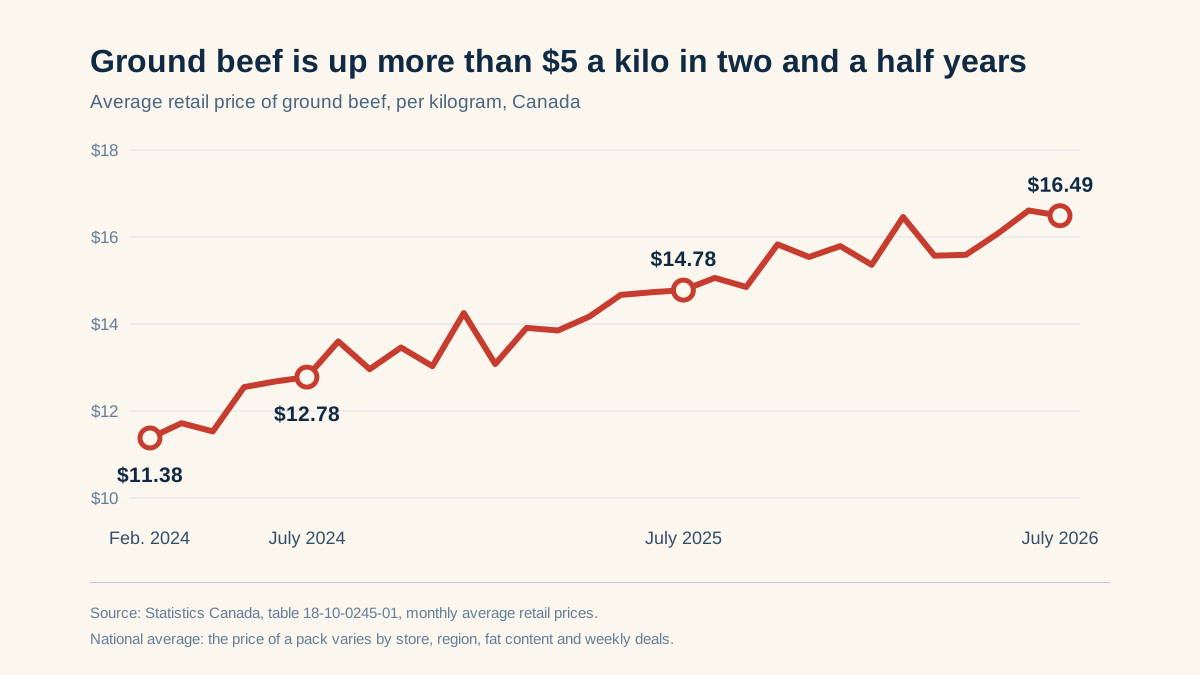
The increase peaked in January 2026, at 22.4% over the year. It has slowed since, but slowing down doesn’t mean coming down: prices are still rising, just a little less quickly. Compared with April 2024, ground beef now costs about 43% more.
As our look at grocery prices in July 2026 shows, the national average hides big gaps, and beef is one of the items pushing the bill up the most.
Why beef has become so expensive
The report sums it up as a perfect storm.
First, there are fewer animals. Higher grain prices a few years ago made raising cattle more expensive, and many producers shrank their herds. Rebuilding a herd takes years, not months.
Second, demand is still strong: shoppers want protein. When supply can’t keep up, prices go up.
Third, drought in the United States is also weighing on the Quebec market. According to the head of a slaughterhouse in Sainte-Thècle, in Quebec’s Mauricie region, interviewed by L’épicerie, American buyers come to Quebec for animals that are in short supply at home. By driving up auction prices, they make selling south of the border more profitable for local producers.
The report also notes that a class action filed in 2022 targets several major beef processors suspected of conspiring to fix the prices Canadian consumers pay. Some companies have settled out of court, while the case continues for others. These are allegations.
Paying more doesn’t guarantee better ground beef
L’épicerie bought 23 packs of lean ground beef, priced from $9 to $47 a kilo, at large grocery chains and a few smaller shops. A butchery instructor and a restaurant owner rated them blind on colour before cooking, texture, flavour and fat.
- Supermarket packs are very uneven. Among the packs with no origin listed, only two earned top marks for flavour: two Provigo products at $23 and $19 a kilo (club size). But according to the butchery instructor, quality varies constantly with the butcher’s skill and the inventory on hand, so a good result one week guarantees nothing the next.
- The best ground beef came from local butchers. Verdun Beef, a Montreal butcher shop that buys from small producers in the Lower St. Lawrence and Gaspésie regions, came out on top, along with an artisanal butcher in Lanaudière. What they have in common: beef raised and processed close to home, and therefore fresher.
- Some big-box products held their own. Products sold at Walmart, Maxi and Costco stood out despite everything. At the other end, Great Value ground beef had the worst results of the test.
- Pricey organic didn’t always impress. Some high-priced organic beef disappointed the tasters. Ground ahead of time at a plant and vacuum-packed, the meat reportedly loses the taste of fresh beef.
The Quebec brands Famille Fontaine and Bœuf Québec also scored well, at around $25 a kilo. The main lesson of the test: price alone tells you almost nothing about what’s in the pack.
Where does the ground beef in your pack come from?
Quebec has hundreds of thousands of cattle, yet the province has never imported so much ground beef, according to the slaughterhouse head the show spoke with.
Lean ground beef is often made from cull cows, meaning dairy cows that have reached the end of their milk-producing years. According to the same source, about half of Quebec’s cull cows are exported, then processed in the United States. Some of that meat then comes back to our shelves.
And the label doesn’t always say so. According to the Canadian Food Inspection Agency, a “Product of” statement followed by the country’s name is required on imported meat that is only packaged or labelled in Canada. Once the meat is processed here, for example ground, that requirement no longer applies. The result, according to the report: a single pack can blend beef from Australia, Canada, the United States or New Zealand without anything on the package saying so.
Our guide to buying Canadian groceries explains what origin claims on labels really mean.
Things could change. The slaughterhouse head testified before a parliamentary committee in Ottawa in February 2026, and recommendations have since been presented to the government to better protect Canada’s food self-sufficiency. According to the report, a Quebec–Ontario pilot project is also about to launch to make local beef easier to find.
How to buy ground beef more wisely
Beef prices aren’t likely to come down quickly. You can still avoid paying a lot for a disappointing product.
Compare by the kilo, not by the pack. It’s the only way to line up a 450 g pack against a 1.2 kg family size.
Check the colour. The L’épicerie tasters immediately marked down meat that looked brownish or greenish before cooking.
Look for a clear origin claim. “Product of Canada” means the processing and labour are Canadian and a significant amount of the ingredients come from Canada. With no claim at all, you can’t assume anything.
Try a neighbourhood butcher or a farmers’ market. Buying closer to the source isn’t always more expensive, because there are fewer middlemen, and the test shows that local beef often tastes best.
Buy on sale and freeze. Ground beef freezes well in portions, which helps you skip the weeks when it’s at its most expensive.
The catch is knowing whether a sale is really a sale. With the BarcodeVibe price tracker, you can follow the packaged ground beef you buy often and check the prices already reported before you stock up the freezer. Packs weighed at the meat counter often carry a store-specific code, and available data varies by product and store. Our guide to reading price history helps you tell a genuinely good price from a flyer headline.
Ground beef is no longer the budget meal it used to be. But as the L’épicerie test shows, the real question isn’t just the price per kilo. It’s what you get for that price.